Diploma Programme (DP) at KEIS
Ages 17 to 19 — Secondary/Gymnasium Years 3 and 4 (IB DP Years 1 and 2)
The IB Diploma Programme (DP) at KEIS is a two-year pre-university programme for students aged 17 to 19. It is one of the most rigorous and widely respected secondary school qualifications in the world — accepted by universities in the United Kingdom, USA, Canada, Australia, Europe, Asia and beyond as evidence of outstanding academic preparation.
The DP represents the apex of the IB continuum at KEIS — two years of concentrated, purposeful academic work in which students move from being guided learners to genuinely independent scholars. Building on the inquiry habits of the PYP and the conceptual thinking of the MYP, students now choose subjects aligned with their strengths and future ambitions, conduct original research, engage in philosophical reflection on the nature of knowledge itself, and contribute to their community through meaningful service. Teachers shift from being facilitators to expert academic guides — rigorous, demanding and deeply invested in each student’s success.
Frequently Asked Questions about IB DP at KEIS
What Makes the DP Different?
For families familiar with the Slovak Maturita or other national secondary qualifications, the IB Diploma Programme represents a fundamentally different approach to the final years of school:
- Breadth and depth combined: students study six subjects across six distinct academic disciplines simultaneously — not just the two or three subjects of most national final-year programmes
- No single exam decides everything: approximately 20–30% of the final grade comes from Internal Assessments (coursework) conducted throughout the two years; the remainder from final written examinations
- University-ready skills built in: the Extended Essay, Theory of Knowledge and CAS are not extras — they are central to the programme and develop exactly the skills universities expect from first-year students
- Global recognition: the IB Diploma is accepted by universities in over 100 countries; grades are set by IBO examiners worldwide, not by individual schools
- Internationally comparable: because all students worldwide sit the same final examinations, IB results carry genuine credibility with university admissions offices
The IB Diploma is more demanding than most national school-leaving qualifications — intentionally so. But the support structures at KEIS — small classes, experienced teachers, continuous feedback and individual university counselling — are designed to help every student rise to that challenge.
DP Programme Structure
The DP spans two years — DP Year 1 and DP Year 2, corresponding to Years 3 and 4 of the KEIS gymnasium. Students study six subjects — one from each of the six IB subject groups — alongside three mandatory core components. This combination ensures academic breadth and the opportunity to specialise in areas of personal strength and interest.
Subject Groups at KEIS
Students choose one subject from each of the six IB subject groups. Three are taken at Higher Level (HL) and three at Standard Level (SL). Subject selection is made carefully in consultation with the DP Coordinator — some university programmes require specific subjects at HL. KEIS provides individual subject selection counselling and can guide students towards universities in Europe and internationally.
Group 1 — Studies in Language and Literature
English A: Literature (HL/SL) — develops critical reading, analysis and interpretation of literary texts. Students explore how language shapes meaning and identity through close study of literary works. Emphasis is on independent thinking, discussion and argumentation, not on memorising literary facts.
Slovak A: Literature (HL/SL) — focuses on analysis of Slovak and world literature, cultural contexts and linguistic proficiency. Students develop the ability to interpret and argue rather than simply reproduce the content of works — a significant shift from the traditional Slovak maturita approach.
Group 2 — Language Acquisition
Spanish ab initio (SL) — designed for students with no prior knowledge of Spanish. Focuses on practical communication, vocabulary and cultural understanding, with an emphasis on active language use in real situations.
English B (SL/HL) — an advanced English course for non-native speakers, focused on language skills, cultural literacy and academic style. Students develop the ability to create and interpret complex texts in a global context, including the study of two literary works in English.
Group 3 — Individuals and Societies
Geography (HL/SL) — integrates physical, environmental and human geography. Students acquire socio-economic and scientific methodologies, developing life skills and an appreciation for diverse perspectives and approaches.
Business Management (HL/SL) — focuses on the functioning of organisations, managerial decision-making and strategic planning in a global environment. Students connect theory with practice through case studies and independent analyses, exploring international business contexts and ethics.
Group 4 — Sciences
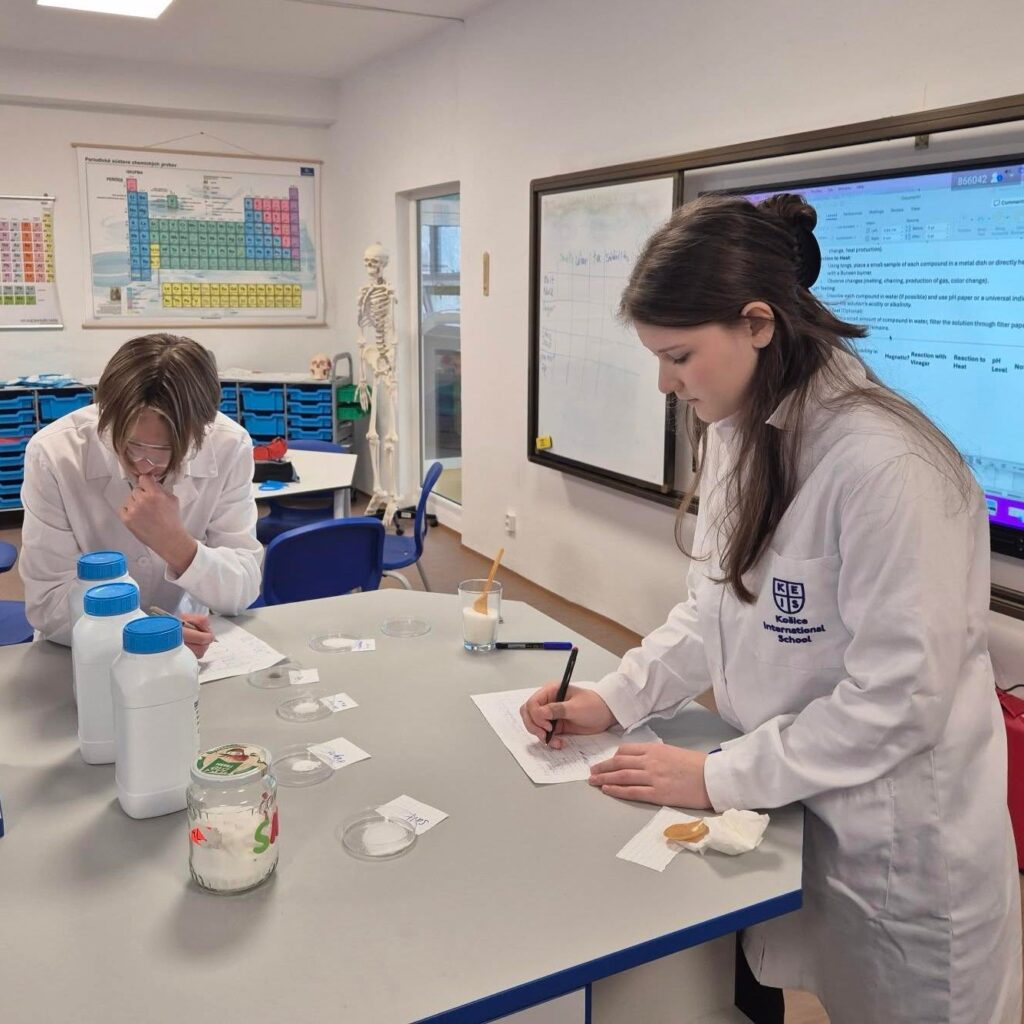
Chemistry (HL/SL) — examines the principles and processes of chemical reactions with a strong emphasis on experimental verification. Students combine theory with laboratory practice, developing scientific reasoning and practical investigative skills.
Biology (HL/SL) — focused on understanding living systems from the molecular level to ecology. Includes laboratory work and an individual research project. Develops the ability to analyse and apply knowledge in varied contexts, going well beyond the fact-based approach of traditional programmes.
Group 5 — Mathematics
Mathematics: Analysis and Approaches (HL/SL) — for students who enjoy abstract mathematical reasoning. Develops the ability to construct, communicate and justify rigorous mathematical arguments, with applications to complex abstract and real-world problems. Highly valued by universities for STEM subjects.
Mathematics: Applications and Interpretation (HL/SL) — develops logical and analytical thinking through algebraic, geometric and statistical tasks. Students apply mathematics to real-world situations using technology. Valued by social sciences, business and interdisciplinary programmes.
Group 6 — Electives
Students may choose an additional subject from Sciences or Individuals and Societies as their sixth subject, allowing further specialisation in areas of strength and intended university pathway.
The DP Core
Theory of Knowledge (TOK)
Theory of Knowledge is one of the most intellectually distinctive elements of the IB Diploma. It asks: how do we know what we know? Students examine different ways of knowing (perception, reason, language, emotion, memory) and different areas of knowledge (mathematics, natural sciences, human sciences, history, the arts). They learn to question assumptions, evaluate the reliability of information and think about knowledge itself as a process — not a fixed set of facts.
TOK is assessed through two components: the TOK Exhibition (an internal assessment in which students select three objects and connect them to a core theme and a prescribed IBO prompt) and the TOK Essay (an externally assessed 1,600-word essay written on one of six titles prescribed by the IBO each year). Strong performance in TOK combined with the Extended Essay can earn up to 3 bonus points towards the IB Diploma total.
Extended Essay (EE)
The Extended Essay is a 4,000-word independent research paper that each student develops on a topic of their own choice within one of the IB subject areas. Students formulate their own research question, conduct genuine academic inquiry, and produce a formally presented essay with proper referencing and argumentation.
The EE develops academic research skills, writing, time management and critical thinking that are directly transferable to university study. Students are supported by a KEIS supervisor throughout the process. Along with TOK, the EE contributes up to 3 bonus points to the IB Diploma total. The Extended Essay also directly builds on the research foundation developed through the MYP Personal Project.
Creativity, Activity, Service (CAS)
CAS is the experiential learning component of the IB Diploma, ensuring that students’ education extends beyond the academic. Students engage across three strands:
- Creativity — artistic, musical, theatrical or other creative endeavours
- Activity — physical activities, sport and fitness
- Service — genuine engagement with the community, addressing real needs
CAS is not a list of hours to complete. Students are expected to reflect meaningfully on their experiences, set personal goals and demonstrate growth. CAS is a mandatory graduation requirement — students who do not complete it cannot receive the IB Diploma regardless of academic scores.
Assessment in the DP
Internal Assessments (IA)
Every DP subject includes Internal Assessments — independent research projects or practical investigations conducted by the student during the two-year programme. IAs take different forms in each subject: literary commentaries, case studies, mathematical explorations, scientific experiments, oral activities and geographical investigations. IAs typically represent 20–30% of the final subject grade and are moderated by external IB examiners to ensure global consistency and objectivity.
Predicted Grades
During DP Year 1 and the first half of DP Year 2, KEIS teachers assign Predicted Grades for each subject. These are realistic estimates of a student’s likely final examination performance, based on IA results, the quality of written work, critical thinking level and consistency in learning. Predicted Grades are critically important for university applications — most universities make conditional offers based on them before final DP results are published. KEIS teachers are expected to provide estimates that are realistic and fair.
Final Examinations
At the end of DP Year 2, students sit final IB examinations — written tests, essays and analytical tasks conducted at KEIS but marked by independent IB examiners at the IBO headquarters. The exams are identical for all IB students worldwide, ensuring global comparability and credibility. Results are published in July each year.
Scoring and the IB Diploma
| How IB Diploma Scoring Works Each subject: graded 1 (lowest) to 7 (highest) Six subjects: maximum 42 points TOK + EE bonus: up to 3 additional points Maximum total: 45 points Minimum for Diploma: 24 points + completion of all core requirements (TOK, EE, CAS) Students who do not meet the minimum threshold receive IB Course Certificates for individual subject results, which many universities also accept. |
University Recognition
The IB Diploma is accepted by universities in the United Kingdom, the United States, Canada, Australia, the Netherlands, Germany, Switzerland, France and virtually every other country with significant higher education. Many of the world’s most prestigious universities — including Oxford, Cambridge, the LSE, ETH Zürich, the University of Amsterdam and leading US universities — actively welcome IB Diploma graduates and value the programme’s academic rigour.
Slovak universities also officially accept the IB Diploma. KEIS graduates can apply to Slovak, European or international universities using their IB results. IB Diploma graduates do not need to sit additional language certification examinations for English — their IB Language A or B results serve as proof of proficiency.
KEIS provides individual university counselling for all DP students, helping them identify programmes that match their interests, strengths and realistic ambitions, and guiding them through application processes for institutions in Europe and internationally.
Admissions to the Diploma Programme
Who is the DP for?
The IB Diploma Programme is designed for motivated, academically capable students preparing for higher education. It suits students who are curious, open-minded and willing to engage deeply with academic subjects while developing critical thinking, research and communication skills.
Entry Requirements
From KEIS MYP (Grade 11): Students completing MYP 5 at KEIS must achieve at least a grade 4 in all subjects and at least a grade 3 for the Personal Project. To choose a Higher Level subject, a consistent grade 5 is required. DP subject selection guidance is provided by the DP Coordinator from October of MYP Year 5.
From Slovak national gymnasium (Year 2): A grade of 1 is recommended for HL subjects; grade 2 for SL subjects. Proof of English proficiency at CEFR B2 level is required (via certificate or entrance test).
From other international schools (IGCSE or equivalent): A/A* (grades 7–9) recommended for HL; B–C (grades 6–7) recommended for SL. Applications reviewed on a case-by-case basis.
Admissions Process
The admissions process for external DP applicants involves the following steps:
- Express interest via the KEIS website — our admissions team will be in contact
- Submit application form, previous school reports and two teacher references
- Meeting with the Head of School and DP Coordinator to discuss the programme
- School visit and optional Trial Day — spend half or a full day in class
- Entrance test and/or English language proficiency evaluation
- Student interview
- Notification of admission decision
- Sign educational agreement; registration and tuition fees payable
- Subject selection in April/May preceding the academic year
KEIS organises an Open Day specifically for prospective DP students in February each year, where the Head of School, DP Coordinator and current DP students present the programme in detail. Individual consultations are available throughout the year.

Frequently Asked Questions — DP
Q: Which universities accept the IB Diploma?
The IB Diploma is accepted by universities in the United Kingdom, USA, Canada, Australia, Switzerland, Germany, the Netherlands, France and the vast majority of countries with significant higher education. Leading universities — including Oxford, Cambridge, ETH Zürich, the University of Amsterdam and many others — explicitly welcome and value IB Diploma applicants. Slovak universities also accept the IB Diploma. If you have a specific university in mind, our DP Coordinator can advise you on entry requirements.
Q: How is the IB Diploma different from Slovak Maturita?
The Slovak Maturita primarily tests content knowledge through written and oral examinations in a fixed set of subjects. The IB Diploma goes further: students study six subjects across a broader range of disciplines, complete a 4,000-word independent research essay (Extended Essay), take a unique interdisciplinary course on the nature of knowledge (Theory of Knowledge), and engage in a programme of creative, physical and service activities (CAS). Assessment includes Internal Assessments in every subject as well as final written examinations. The DP demands genuine intellectual independence and develops university-ready skills that the Maturita does not systematically address.
Q: Can a student from a Slovak gymnasium apply directly to the DP at KEIS?
Yes. Students completing Year 2 of a Slovak gymnasium may apply to join KEIS in DP Year 1. Entry requirements include strong academic results (grade 1 recommended for HL subjects), English proficiency at CEFR B2 level, and successful completion of the admissions process including an interview and two teacher references. We encourage interested families to begin the process early, as places are limited.
Q: My child wants to study medicine, law or engineering at university. Is the DP the right choice?
The DP is an excellent preparation for competitive university programmes in medicine, law, engineering, economics and the sciences. For medicine and engineering, Chemistry or Biology at HL and Mathematics: Analysis and Approaches at HL is typically recommended. For law, social sciences or business, English A: Literature HL, Business Management HL and/or Geography HL are strong choices. Our DP Coordinator provides personalised subject selection counselling aligned with each student’s intended university pathway.
Q: What is the Extended Essay, and how much time does it take?
The Extended Essay is a 4,000-word independent research paper on a topic of the student’s own choice within an IB subject area. Students formulate their own research question, conduct original research and write a formally structured academic essay with the guidance of a KEIS supervisor. It is spread across both DP years and typically requires around 40 hours of independent work. It develops exactly the research and academic writing skills that universities expect from first-year students.
Q: What if my child doesn’t achieve enough points for the full IB Diploma?
Students who complete the DP course but do not achieve the minimum 24 points for the full Diploma receive IB Course Certificates for each individual subject. These certificates carry significant weight with universities — many institutions accept them as evidence of DP participation and subject-level achievement. Our DP Coordinator can advise on specific university requirements in this scenario.
Q: Is the DP only for academically exceptional students?
The DP is designed for motivated, academically capable students — not exclusively for the top 1%. What matters most is genuine motivation, willingness to work hard and independently, and openness to intellectual challenge. KEIS provides significant support throughout the two years: teachers give continuous feedback, the DP Coordinator monitors each student’s progress, and the school explicitly teaches study skills and time management. Students who commit fully to the programme typically achieve outcomes that exceed their own expectations.
Q: What is the school fee for the DP, and are there scholarships?
KEIS offers subsidised tuition (a scholarship of up to 65%) for families where at least one parent or the child holds Slovak citizenship. For the 2026/27 school year, the monthly fee with scholarship for the gymnasium (including DP) is €650/month. Full fee information is available on the School Fees page of our website. We encourage early registration to secure your place and the most favourable fee conditions.